Yi Jin Jing – Tendons Changing Classic
There is an old Chinese saying: 「筋長一寸,壽延十年。筋長一寸,力大一分。」 The first sentence means when your tendons grow an inch longer, you can live 10 years more. Of course, it is not exact science. However, the strength and suppleness of your tendons does strongly influence both your physical health, and your overall sense of somatic and psychological wellbeing. Yi Jin Jing set of exercises is meant to improve the health of your tendons.
Yi Jin Jing Tendons Changing Considerations
In Traditional Chinese Medicine (TCM), the term tendons also applies to ligaments and fascia. As we age, our tendons shorten and lose their original elasticity. Since our tendons (in the TCM usage of the term) cover, connect, and protect every single organ, nerve and muscle fiber in the body, if they are weakened, many health issues can arise. For example: as your tendons contract, this potentially can pull the muscles and bones attached to them, thereby causing skeletal misalignments that frequently can result in the sort of chronic pain commonly experienced in the neck, shoulders, back and legs. If left untreated over a prolonged period of time, this can lead to numbness in these areas resulting from the reduced blood and qi circulation. That’s why in TCM, it says: 「骨正筋柔,氣血自流」’if your bones are aligned properly and the tendons are elastic, blood and qi flow will naturally be smooth.’
Nowadays, due to the technological revolution, most people spend far more time than ever before, sitting (often with poor posture) in front of their TVs, computers, smartphones, etc. and far less time is spent doing physical work. As a result of these unhealthy habits, the aforementioned patterns of chronic pain, prevalent mostly among the older population, are increasingly becoming more commonly seen in younger generations, who, biologically speaking, are ‘catching up’ with their elders.
「筋長一寸,力大一分。」 The second sentence means when your tendons grow an inch longer, your physical power increases by 10%. If you look at the Chinese character of 筋, it has 3 parts. The top part is the shortened version of 竹, and translates as ‘bamboo’, a very long and elastic plant; left part is 月, meaning ‘moon’, which also represents yin as well as organic matters; the right part is 力, which means force. From this, you can infer that the force generated by the tendons, is influenced by their length and elasticity. Also, this force differs from the force that is generated by muscles. It is a more internal and elastic (yin) force, which inner martial artists refer to as ‘Jin’ 勁. Since this force is generated by the quality of a person’s qi and tendon strength, rather than by their muscles, a small, lightweight person who masters this force, can demonstrate as much strength, than a heavyweight body builder whose pure muscle strength may be considerably greater. And this inner strength is the fundamental focus of internal martial arts training.
Modern science supports this theory. Various investigations into the incredible jumping ability of kangaroos found their muscles alone aren’t large enough to provide those powerful jumps. Their secret is the moment before they hop in the air, the strong and elastic tendons in their hind legs are elongated and stretched. This creates a substantial tensile force, causing the tendons to become like a powerful elastic band stretched close to its maximum; for a brief moment, a vast amount of ‘elastic potential energy’ is stored in the legs before it is all released as the tendons contract and launch the kangaroo into the air. So Kangaroo hind legs work like springs, compressing and elongating, storing and releasing elastic energy in the process. This also explain their amazing endurance as the vast majority of the energy they use, comes from the tendons, and unlike muscles, tendons do not fatigue, nor do they require oxygen to function.
Although we humans can’t jump as far as kangaroos do, our tendons and fascia share a similar capacity for storing kinetic energy. Moving with light, quiet footsteps reliably indicates that a person is walking, or running, elastically. Similarly, in tai chi, we should move our legs and feet, as if we are walking on thin ice, or imitating a panther’s stealthy motions as it attempts not to alert its prey. Heavy or loud footsteps indicate that someone is moving in a manner that requires a lot of extra, unnecessary, energy expenditure, which is a mode of walking that is not nearly as efficient or sustainable as moving elastically.
Tendons training is also important for injury prevention. Studies found the most serious and frequent injuries, especially among sportsmen but also in the general population, occur not in the muscles and bones, but in the connective tissue comprising the muscle-ligament-tendon junctions. And in spite of the fact that these injuries most often result from an overloading of the fascial tissue, in particular the tendons and ligaments, most training seems to focus a massively disproportionate amount of time on developing muscle power and cardio fitness, rather than on exercises that improve the strength, flexibility and overall health of the tendons and ligaments and other connective tissues, which play a far more powerful role in protecting us from physical injury.
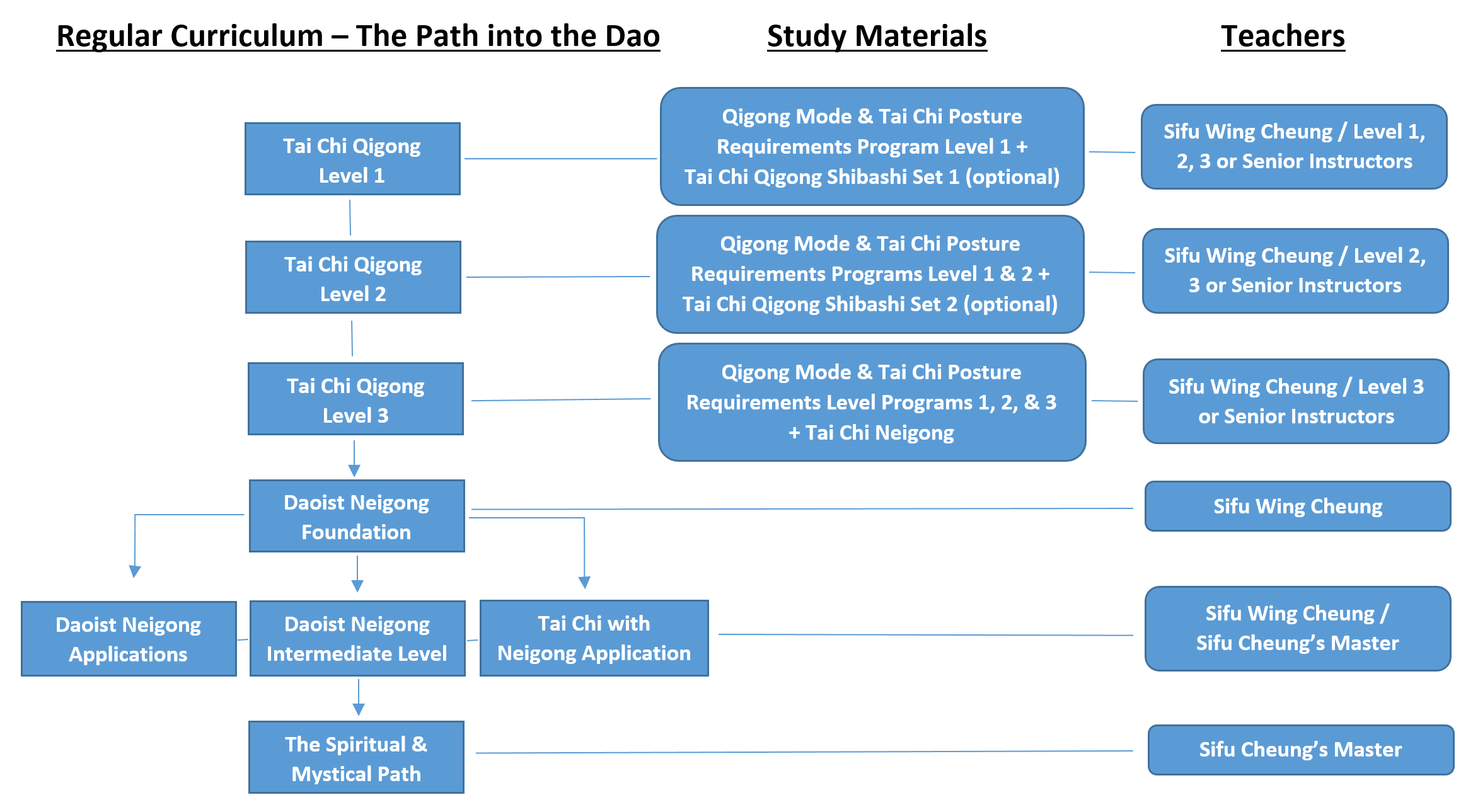
The good news is that with proper training you can, at any age, restore our tendon health to its optimal state provided that you don’t have any serious liver issues because liver greatly influences the health of tendons. And if you have been following our school’s curriculum and have already progressed gradually from Level 1 to Level 3, your qi should now be able to penetrate the fascia deeply enough to reach the tendons, where it can provide sufficient ‘qi nourishment’ to revitalise and regenerate them. However, this may require months or years to achieve. Fortunately, there is also another training method called ‘Tendons Changing Classic’ or, ‘Yi Jin Jing’ (YJJ) which focuses specifically on the tendons, thereby providing faster results.
The Yi Jin Jing set of exercises included in this course, is based on the teaching of Master Cheng Wing Kwong. It has 12 simple tensiometric exercises, plus 1 practice for sexual potency (for males). It has more depth than the other YJJ practices that I have collected throughout the years. The way in which the tendons are engaged progressively is very similar to how the nei qi flows in tai chi neigong. Thus, this version of Yi Jin Jing is a good complement to tai chi neigong, and additionally, it will complement and enhance the practice of traditional tai chi chuan – which is to be expected, since Cheng Wing Kwong is a renowned tai chi master.
For example, there is a 3 Rings Theory in Tai Chi and one of the movements in YJJ provides good training for practicing and applying this theory:
Enhancing Sexual Potency for Men (optional practice)
In ancient times, these methods for enhancing sexual potency were highly guarded secrets. Some even called them Jin Bu Huan (金不換), meaning ‘will not even exchange for gold’. Even today, when ‘blue pills’ are readily available, this knowledge is still invaluable.
This Yi Jin Jing practice is not only a completely natural means for enhancing sexual potency and fertility, which is free of harmful side effects, but additionally, it will boost the health of your reproductive system and, most particularly, your testes.
Pre-requisites for Yi Jin Jing Course:
- If you have serious high blood pressure, you will need to modify some movements in this course, we also suggest you to practice Tai Chi Qigong for Hypertension.
- It is highly recommended you mastered the basic skills from the Qigong Mode & Tai Chi Posture Requirements Level 1 Course.
Pre-requisites for the Male Sexual Potency Course:
- Familiarity with Dan Tian Breathing.
- An ability to guide qi precisely within the body.
- You can learn the above from the Level 1 & 3 Qigong Mode courses respectively.
Program includes (download version only):
- Video demonstration of the 12 tensiometric exercises. (1 hour)
- Instruction manual with detail descriptions and illustrations.
Optional Male Sexual Potency Course: Instruction manual only
Add to Cart:
Price range: $15.00 through $49.00Select options This product has multiple variants. The options may be chosen on the product page